SMS Marketing continues to deliver among the highest engagement rates of any digital communication channel.
SMS Marketing open rates outperform Opt-in Email campaigns across most industries.
SMS Marketing conversion rates remain strong for retail promotions, operational alerts, and nonprofit engagement.
Subscriber opt-outs increase when message frequency exceeds customer expectations.
TCPA compliance remains essential for avoiding penalties and protecting sender reputation.
Organizations should track revenue, engagement, and retention metrics to measure the ROI of SMS Marketing.
The easiest way to understand the growth of SMS Marketing is to start with one simple question: Where are consumers spending their time? Increasingly, the answer is on mobile devices. Text messaging has become one of the most effective communication channels available to organizations today. It also remains one of the fastest ways to reach people where they already spend their time.
This report brings together the latest SMS Marketing statistics, open rate benchmarks, conversion data, consumer behavior trends, compliance insights, and ROI metrics shaping business messaging in 2026.
SMS Marketing Statistics Show Why Organizations Are Increasing Investment
SMS marketing has moved well past the “early adopter” phase. As of 2025, approximately 84% of consumers have opted in to receive texts from at least one business, which is a significant increase from just a few years ago. What this means for business is that your audience is expecting a text from you for appointment reminder, payment reminders and event notifications.
SMS Marketing Adoption Continues to Grow Across Industries
Consumer adoption remains one of the strongest indicators of SMS Marketing’s continued growth. Recent research shows that 82% of consumers text daily and 62% of consumers are already receiving texts from more than four businesses.
We also see the same behavior from about 75% businesses who are leaning towards text-based marketing. This spike in numbers shows that consumer behavior is shifting. While there was a point where customers felt hesitant to share their mobile numbers with businesses, today they subscribe to receive texts from multiple organizations because of the value they perceive from that channel.
How Organizations Are Shifting Budget Toward SMS Marketing
SMS adoption growth is showing up in marketing budgets, too. Around 60% of business owners plan to increase their SMS marketing spend. Compared to social media advertising or email campaigns, SMS offers better value for money spent and direct delivery to an engaged audience. Cost per message ranges between $0.02 to $0.04, and subscriber acquisition costs are as low as $0.45. With this, SMS offers a cost-per-reach that’s hard to beat
The Most Important SMS Marketing Benchmarks for 2026
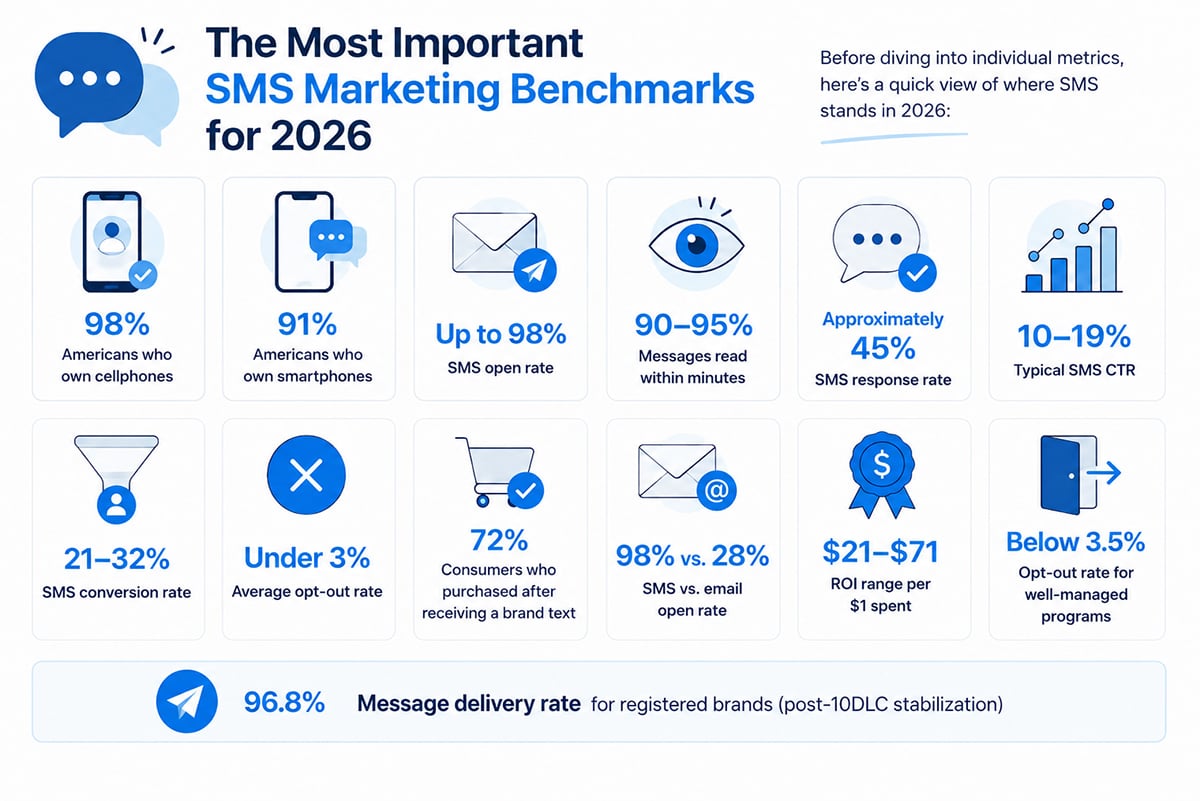
Before diving into individual metrics, here’s a quick view of where SMS stands in 2026:
Americans who own cellphones: 98%
Americans who own smartphones: 91%
SMS open rate: Up to 98%
Messages read within minutes: Up to 90-95%
SMS response rate: Approximately 45%
Typical SMS CTR: 10-19%
SMS conversion rate: 21-32%
Average opt-out rate: Under 3%
Consumers who purchased after receiving a brand text: 72%
SMS vs. email open rate: 98% vs. 28%
ROI range: $21-$71 per $1 spent
Opt-out rate: Below 3.5% per send for well-managed programs
Message delivery rate: 96.8% for registered brands (post-10DLC stabilization)
SMS Marketing Open Rate Statistics Continue to Outperform Email
Every marketing channel competes for attention. Before a customer can click, convert, donate, register or respond, they must first see your message. It is this visibility gap that SMS continues to fill distinctively from other communication channels like email.
Compared to SMS, emails get filled up and can be easily ignored. On the other hand, text messages benefit from direct delivery and consumer habits that favor immediate engagement.
Average SMS Marketing Open Rate Benchmarks
You’ve probably read somewhere that SMS messages have a 98% open rate. But what does it actually mean in practice? It simply means that when you send a text, it almost certainly gets seen. Other studies often place this stat between a careful range of 90-98%, depending on how open is defined.
Some of that figure reflects device-level previews visible directly from the lock screen rather than a deliberate tap-and-read. But even at the lower end of that range, SMS lapses every other marketing channel.
SMS Marketing vs Opt-in Email Performance
Almost no other marketing channel touches emails for detailed communication like sharing long updates, newsletters, reports, and promotional content.
Yet when you compare message visibility, SMS outperforms emails. Depending on audience quality and industry, email open rates fluctuate between 20-40%.
Metric
SMS
Email
Open rates
90-98%
20-28%
Response rates
45%
6%
Average CTR
10–19%
2–4%
ROI per $1 spent
$21–$71
$10–$36
Why SMS Marketing Messages Are Read Within Minutes
While open rates tell you whether a message gets seen, read speed tells you when, and that’s where SMS pulls ahead of other channels. Around 32% of recipients open a text within 60 seconds of receiving it. Within 5 minutes, that number climbs to 81-82%. Within 3 minutes, roughly 90% of SMS messages have been read.
For context: email campaigns are often measured in hours or days before open rate data even stabilizes.
Now imagine you’re sending an emergency alert or a flash sale, the difference in read speed is the difference between reaching people in time and them missing the window entirely.
SMS Marketing Conversion Rate Benchmarks Across Industries
Open rates and clicks matter, but conversion is where the real value is. The good news is that SMS delivers here, too.
Retail and Mobile Commerce Conversion Statistics
Retail remains one of the strongest-performing SMS Marketing sectors. Across well-optimized retail campaigns, SMS conversion rates range from 21% to 32%. For context, cold calls convert at just 2.3%. For specific use cases, the numbers get even more compelling:
Interactive SMS (polls, surveys): 70% conversion rate, compared to 36% for static messages
Infobip found that 72% of consumers made at least one purchase after receiving a brand text. An even more telling figure: 86% made multiple purchases from a branded SMS in the past year alone.
Nonprofit and Church SMS Marketing Engagement Data
School, Utility, and Emergency Notification Results
For schools, utilities, and emergency management organizations where purchase conversion metric doesn’t necessarily apply, SMS can help improve action rates. For instance, in a study, over 80% of people want appointment reminders via SMS, and nearly 75% prefer text updates for service notifications. For organizations like schools that have similar goals, it can be detrimental to look away from these numbers.
Service Business and Staffing Industry Benchmarks
Staffing agencies, healthcare practices, and service businesses use SMS primarily for scheduling, confirmations, and rapid coordination. According to Business.com, response rates tend to run as high as 45% on average, compared to 6% for email.
SMS Marketing Click-Through Statistics Compared to Push Notifications
Average SMS Marketing Click-Through Rates
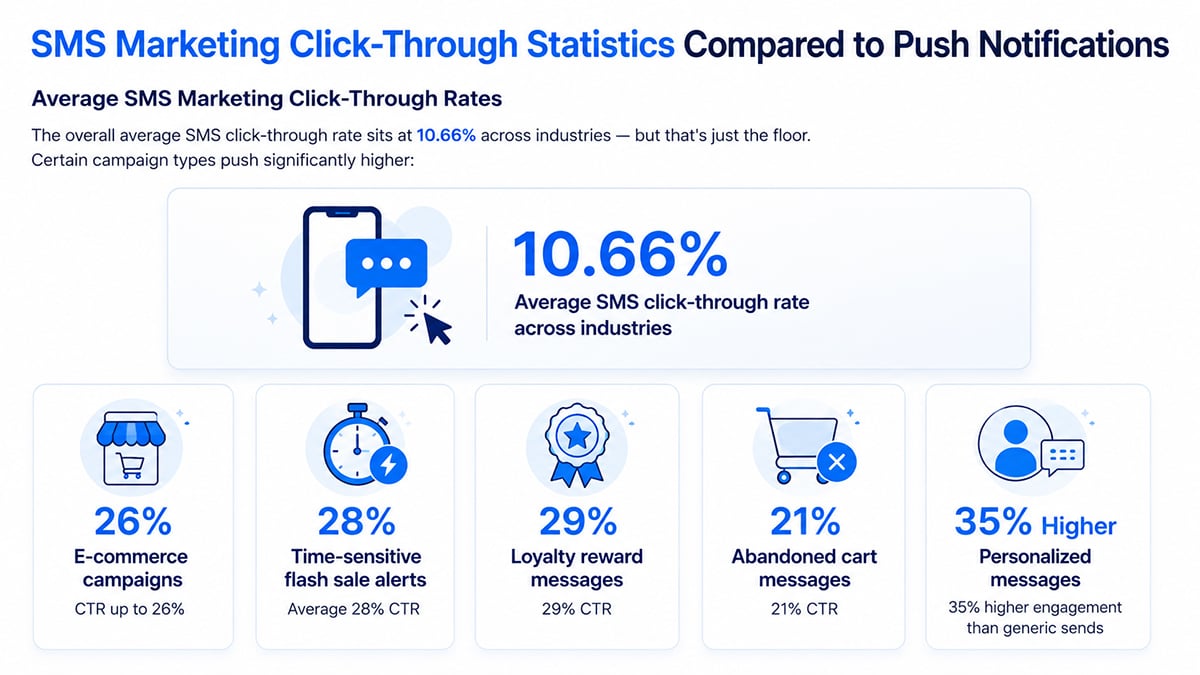
The overall average SMS click-through rate sits at 10.66% across industries – but that’s just the floor. Certain campaign types push significantly higher:
E-commerce campaigns: CTR up to 26%
Time-sensitive flash sale alerts: Average 28% CTR
Loyalty reward messages: 29% CTR
Abandoned cart messages: 21% CTR
Personalized messages: 35% higher engagement than generic sends
Compare any of those to email’s average CTR of 0.77-4.36%, and the performance gap becomes almost uncomfortable to look at.
SMS Marketing vs. Push Notification Performance
SMS read rates are 40% higher than push notifications. Push notifications have become easy to dismiss as they appear in app notification trays that many users clear or have turned off. Text messages arrive in the native messaging app, alongside personal conversations, which creates a different kind of attention.
Why Native Text Messaging Drives Immediate Visibility
SMS has an advantage that is already woven into its structure. It arrives and lives where people already communicate daily. The average smartphone owner unlocks their phone 96-150 times per day and checks it around every 10-12 minutes during waking hours.
Also, over 90% of people send and receive texts every day. That built-in habit drives the visibility numbers that other channels simply can’t replicate.
SMS Marketing Subscriber Behavior and Opt-Out Statistics
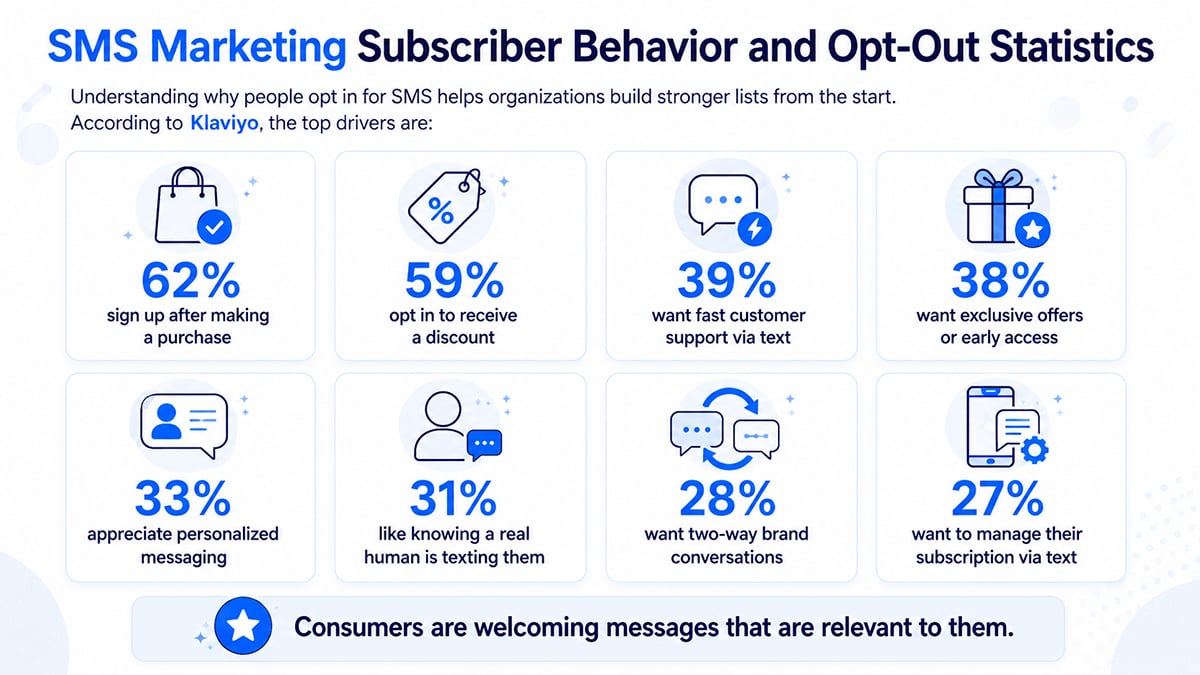
Understanding why people opt in for SMS helps organizations build stronger lists from the start. According to Klaviyo, the top drivers are:
62% sign up after making a purchase
59% opt in to receive a discount
39% want fast customer support via text
38% want exclusive offers or early access
33% appreciate personalized messaging
31% like knowing a real human is texting them
28% want two-way brand conversations
27% want to manage their subscription via text
If this data shows anything, it is that consumers are welcoming of messages that are relevant to them.
Typical SMS Marketing Unsubscribe Rates
One of the most encouraging SMS Marketing statistics is how low unsubscribe rates tend to be, with the number falling below 3%.
Here is a broader explanation: while consumers are comfortable receiving messages from organizations they trust, provided the message delivers value, 61% of subscribers who opt out cite receiving too many messages as the primary reason.
How Message Frequency Impacts Subscriber Retention
Frequency is the single fastest way to lose an engaged subscriber. To maintain strong subscriber retention, focus more on message relevance during the opt-in process.
But the question most marketers ask is how many texts are too many?
Back to Klaviyo consumer data:
72% of consumers are comfortable receiving at least one text per week.
32% prefer receiving messages a few times per week.
27% prefer weekly messaging.
Only 13% are comfortable with daily text messages.
Consumers generally want communication, but it shouldn’t feel excessive.
The Most Common Reasons Consumers Opt Out
Aside from frequency, there can be other reasons your customers are opting out of receiving your text messages. Common triggers include:
Messages that no longer align with their expectations
Too many messages
Irrelevant promotions
Poor personalization
Repetitive content
Lack of perceived value
Messages sent at inconvenient times
Warning Signs of SMS Marketing Fatigue
Subscriber fatigue develops gradually. And the biggest challenge is recognizing the warning signs before subscribers begin opting out in large numbers. Always watch out for:
Declining click-through rates
Lower response rates
Reduced conversion rates
Increasing opt-outs
Reduced engagement among previously active subscribers
These signals often indicate that the campaign has either overextended on frequency or drifted away from content that subscribers find useful and relevant.
Maximize Outreach, Save Time
Start Transforming Your Communication with Mass Texting
SMS Marketing Compliance Statistics and TCPA Requirements
It’s one thing to have strong engagement, but it means very little if an SMS campaign creates compliance risk.
The Telephone Consumer Protection Act (TCPA) remains one of the most important regulations affecting SMS Marketing programs in the United States. If your organization is using text messaging, compliance is non-negotiable.
TCPA violations carry fines of $500 to $1,500 per individual message. In class-action cases where a single campaign might have sent millions of non-compliant texts, the exposure can be catastrophic. In 2025 alone, TCPA litigation surged by 95%, and total settlements exceeded $150 million. The Telephone Consumer Protection Act requires prior express written consent before any promotional text message is sent. That means:
Consent must be specific to your organization
It must be clearly documented
It must be obtained before the first message
Contacts from purchased lists, lead aggregators, or partner data shares are presumed to lack valid consent and must be re-consented before messaging
Consent and Opt-In Benchmarks Organizations Should Track
As of April 2025, FCC rules require that opt-out requests be honored through any reasonable method, not just the STOP reply. That includes opt-outs submitted via email, phone calls, website forms, or in person. Organizations have 10 business days to process them.
Similarly, any business sending texts from a 10-digit number in the U.S. must register through The Campaign Registry (10DLC). Without registration, messages get filtered or blocked by carriers regardless of consent documentation.
On consent documentation, it is a checklist that demonstrates a subscriber knowingly agreed to receive messages. Every organization should maintain records showing:
How consent was collected
When consent was collected
What disclosures were presented
Which phone number opted in
Whether opt-out requests were processed
Organizations should periodically audit these records to ensure documentation remains complete and accessible.
Common SMS Marketing Compliance Failures
The most common compliance mistakes organizations make include:
Sending messages without documented consent
Failing to process opt-out requests within the required timeframe
Not providing a clear opt-out mechanism in every message
Sending messages without 10DLC registration
Inconsistent consent language
Poor recordkeeping practices
Using purchased contact lists
SMS Marketing Compliance Audit Checklist
Use this as a starting point for reviewing your program:
☐ All subscribers provided documented, written consent specific to your organization
☐ Opt-in records include the date, source, and method of consent collection
☐ Every message includes a clear opt-out instruction
☐ Opt-out requests are processed within 10 business days, across all inbound channels
☐ Sending number is registered through The Campaign Registry (10DLC)
☐ No messages are sent between 9 PM and 8 AM local time
☐ Contacts from purchased or shared lists have been re-consented before inclusion
Conversion and open rates are results, but to earn these high metrics that SMS promises, you need a strong infrastructure.
In summary, the strongest text messaging results come from your organizations that invest in both quality messaging strategy and messaging infrastructure.
Short Code Adoption and Performance Benchmarks
Short codes – five or six-digit numbers used for high-volume texting – often offer faster throughput and deliverability for large-scale campaigns.
Organizations often use short codes for:
Promotional campaigns
Alerts and notifications
Voting campaigns
Subscriber opt-ins
Large-scale engagement programs
Short codes can support significantly higher message volumes than traditional phone numbers, making them valuable for organizations managing large subscriber databases.
Long Code vs Short Code Delivery Performance
Both long codes and short codes play important roles in business messaging. Short codes generally provide higher throughput for large messaging volumes, while long codes support more conversational use cases and lower-volume communication. However, the right choice depends largely on use case and volume.
Messaging Infrastructure
Best Use Case
Long Code
Two-way conversations
10DLC
Business messaging at moderate scale
Short Code
High-volume campaigns
Toll-Free SMS
Customer service and alerts
The Role of Automated Messaging Platforms
Automation is what separates high-performing SMS campaigns from under-performing ones. Across high-performing organizations, 64% of SMS revenue comes from automated flows rather than one-off campaigns. Automated sequences like welcome messages, reminders, follow-ups, and re-engagement series deliver consistent results without requiring manual execution each time.
Why Subscriber Database Quality Impacts Results
Many marketing teams pursue increase subscriber lists when they should be chasing improving the quality. A large contact list provides little value if the data is outdated, inaccurate or wrongly segmented.
Whereas, a smaller list of people who opted in deliberately because they want to hear from you will outperform the former.
High-performing SMS programs typically maintain:
Accurate subscriber information
Current phone numbers
Segmented audiences
Verified consent records
Regular list hygiene practices
SMS Marketing ROI Statistics Every Manager Should Track
While engagement metrics provide useful insights, return on investment remains one of the most important measurements for evaluating SMS Marketing performance.
Fortunately, SMS continues to perform well across a variety of ROI indicators.
Revenue Per Message Benchmarks
Business surveys found that 76% of organisations agree that SMS marketing drives revenue. While it can vary by industry, text messaging often delivers $71 ROI per $1 spent. And compared to many digital channels, SMS frequently performs well because of its visibility and engagement advantages.
Cost Per Conversion Metrics
SMS costs 3-5 times less than paid social for the same conversion, with per-message costs typically running $0.01-$0.03. Combined with conversion rates in the 21-30% range for optimized programs, while subscriber acquisition costs can be as low as $0.45 his keeps overall program economics favorable even at modest scale.
Customer Retention and Repeat Purchase Impact
Retention is often where SMS Marketing delivers its greatest long-term value. Around 86% of consumers made two or more purchases in the last year directly from a branded text, hile 72% of consumers have purchased after receiving a brand text.
Similarly, the average customer spends 22% more when regularly engaged via SMS. For organizations focused on donor retention, membership renewal, or repeat service utilization, those numbers translate directly to long-term program value.
Building an SMS Marketing ROI Dashboard
Track these metrics to measure program performance:
Revenue per message sent: total campaign revenue ÷ messages sent
Subscriber list growth rate: new opt-ins per month
Opt-out rate per campaign: monitor trend, not just individual sends
Click-through rate: benchmark by campaign type
Conversion rate: segmented by campaign type and audience
Cost per conversion: total campaign spend ÷ conversions
Retention rate: what percentage of subscribers remain active after 90 days?
Consumer Communication Preferences Continue to Favor SMS Marketing
Research consistently shows that text messaging remains one of the most preferred communication channels for time-sensitive updates and operational notifications.
Text Messaging vs Phone Call Preferences
There was a time when a phone call was the default way to reach someone. But that has changed over time. About 90% of B2B business leads say they’d prefer to be contacted by text rather than a phone call.
Consumer Preferences for School and Community Alerts
Texting is now the expected channel for time-sensitive community communication. Over 80% of consumers want appointment reminders via SMS. Nearly 75% prefer text updates for service and delivery notifications. For schools sending attendance alerts or safety updates, this preference aligns well with the urgency these messages carry.
Why Customers Prefer SMS Marketing for Service Updates
Texting is the top mobile activity for 83% of consumers, ahead of social media (75%) and email (66%). That figure has climbed steadily each year from 77% in 2022 to 83% in 2025, making the direction of travel clear. For organizations deciding where to invest communication resources, that trend points toward text.
The Future of Mobile-First Communication
One more trend worth noting: the scope of SMS marketing is changing at the infrastructure level. RCS (Rich Communication Services) is gaining real commercial traction in 2026. Twilio’s State of Customer Engagement research found that 75% of business leaders plan to invest in emerging messaging channels such as RCS, reflecting broader investment in mobile communication strategies.
What SMS Marketing Statistics Mean for Organizations in 2026
The question is no longer whether SMS Marketing works. The more important question is how organizations can apply these benchmarks effectively.
Organizations that use SMS primarily as a broadcast tool – sending information without expecting or enabling a response – are leaving significant performance on the table. The data shows that two-way, interactive, personalized messaging outperforms static blasts by wide margins.
Where SMS Marketing Delivers the Greatest Business Value
Not every use case produces the same results. The strongest SMS Marketing outcomes generally occur when organizations need visibility, speed, and direct engagement.
Common high-performing applications include:
Promotional campaigns
Flash sales
Appointment reminders
Event registrations
Fundraising campaigns
Customer retention programs
Emergency notifications
Operational alerts
How to Apply These SMS Marketing Benchmarks
Use industry benchmarks as starting points, not targets. A 98% open rate is a structural reality of how SMS works; your click-through and conversion rates depend on list quality, message relevance, and timing. Set your baseline using your first three months of campaign data, then measure improvement against your own history.
Building a Sustainable SMS Marketing Strategy
The most effective SMS programs share a few characteristics:
Subscribers opted in willingly and clearly understand what they’ll receive
Message frequency is consistent and predictable
Content delivers genuine value,
Compliance is built into the program infrastructure
Performance is tracked at the campaign level, with regular review of opt-out trends
How DialMyCalls Helps Organizations Improve SMS Marketing Results
Statistics describe what’s possible. However, the gap between what’s possible and what organizations actually achieve usually comes down to infrastructure. This includes the platform process and the tools that make high-performing SMS marketing achievable for teams that don’t have a dedicated technical department. This is where DialMyCalls comes in. It is a mass notification system built for various organizations that need to reach large groups without friction.
Send high-volume messages from a single platform.
DialMyCalls handles sending messages to small and large groups without requiring multiple tools or manual processes. Messages go out instantly, across your full contact list, with consistent delivery
Manage subscriber lists and consent records
DialMyCalls makes it simple to organize contacts into groups, track opt-in status, and maintain clean, segmented lists that keep your program compliant and your performance strong. Contacts who opt out are removed automatically, protecting your organization from TCPA exposure.
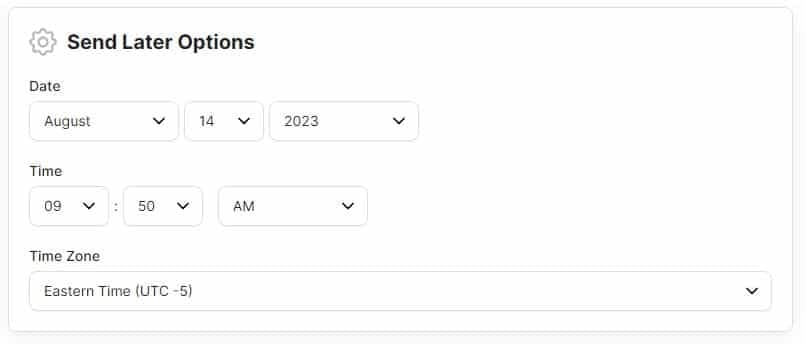
Schedule campaigns and operational alerts
Send reminders at the right time without requiring manual execution. For organizations running recurring communications like weekly volunteer updates, monthly donor appeals, and quarterly check-ins, scheduling keeps the program consistent without adding ongoing workload.
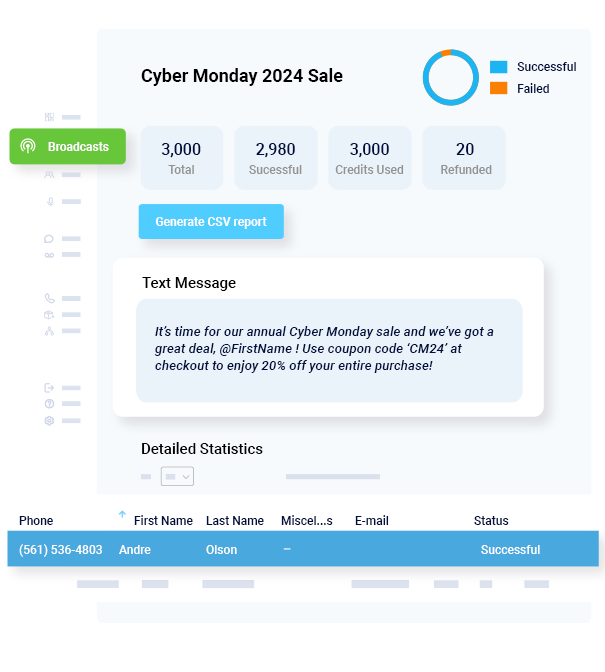
Track delivery and engagement metrics
DialMyCalls provides delivery confirmation and engagement tracking so you can see what’s working, identify what isn’t, and improve campaign after campaign. Track the metrics that matter, such as CTR, opt-out trends, and delivery rates.
Support compliance and opt-out management
Staying on the right side of TCPA requires more than intention. DialMyCalls supports compliant program management by making opt-out processing straightforward, keeping your sending infrastructure registered, and maintaining the documentation that protects organizations if a compliance question arises.
To explore SMS broadcasting and mass texting for your organization, start your free trial today and send your first message in minutes.
Conclusion
SMS marketing in 2026 is a foundational communication channel with open rates, response rates, and ROI figures that consistently outperform nearly every alternative.
The stats mentioned in this article, such as $12.6 billion market size, the 98% open rates, the 45% response rates, and the $21-$71 returns per dollar spent, are benchmarks from multi-industry research that reflect what happens when organizations communicate with subscribers who opted in, at a cadence that respects their preferences, through a platform that handles delivery and compliance reliably.
The organizations that see the strongest results are the ones that approach SMS with discipline: clean lists, relevant content, consistent cadence, and a commitment to delivering value to the people on the receiving end.
Those habits, supported by the right tools, are what separate organizations that run great SMS programs from the ones still wondering why theirs isn’t working.
Frequently Asked Questions
What is the average SMS marketing open rate in 2026?
Most industry benchmark studies report SMS open rates approaching 98%, making SMS one of the highest-visibility communication channels available.
How does SMS marketing compare to email marketing?
SMS Marketing generally produces higher open rates and faster read times than email. While email remains valuable for detailed communication, SMS is often preferred when immediate visibility is important.
What industries see the highest SMS marketing conversion rates?
Retail, eCommerce, staffing, nonprofit fundraising, appointment-based services, and event-driven organizations often report some of the strongest SMS Marketing conversion rates.
How often should businesses send SMS marketing messages?
Consumer research suggests most subscribers are comfortable receiving at least one text per week, though ideal frequency depends on audience expectations and message relevance.
What is a good SMS marketing click-through rate?
Many organizations report click-through rates above 20%, although performance varies by industry, audience, and campaign objective.
What TCPA requirements apply to SMS marketing?
Organizations generally must obtain proper consent, maintain opt-in records, provide clear opt-out instructions, and comply with applicable FCC and TCPA requirements.
Should businesses use a short code or long code for SMS marketing?
Short codes are often better suited for high-volume campaigns, while long codes are commonly used for conversational messaging and smaller-scale communication.
How do you measure SMS marketing ROI?
SMS Marketing ROI is typically measured using metrics such as open rates, click-through rates, conversion rates, revenue generated, subscriber growth, retention rates, and overall return on investment.
Maximize Outreach, Save Time
Start Transforming Your Communication with Mass Texting
Tim Smith is the Media Manager at DialMyCalls, where he has leveraged his expertise in telecommunications, SaaS, SEO optimization, technical writing, and mass communication systems since 2011. Tim is a seasoned professional with over 12 years at DialMyCalls and 15+ years of online writing experience.
“I am a youth minister and have spent hours in the past calling students individually to remind them of an upcoming event or to get out an urgent announcement. With DialMyCalls.com, I cut that time down to about 1 minute. I also love how I can see exactly who answered live and how long they listened so I know if they heard the whole message. DialMyCalls.com is the best website I have stumbled upon all year! Thanks!”
Real Results, Real ReviewsOver 40,000 customers trust our platform – and it shows.
4.3
502 Reviews
4.7
836 Reviews
Author
Tim SmithMedia Manager
Tim Smith is the Media Manager at DialMyCalls, where he has leveraged his expertise in telecommunications, SaaS, SEO optimization, technical writing, and mass communication systems since 2011. Tim is a seasoned professional with over 12 years at DialMyCalls and 15+ years of online writing experience.
“I am a youth minister and have spent hours in the past calling students individually to remind them of an upcoming event or to get out an urgent announcement. With DialMyCalls.com, I cut that time down to about 1 minute. I also love how I can see exactly who answered live and how long they listened so I know if they heard the whole message. DialMyCalls.com is the best website I have stumbled upon all year! Thanks!”
Fill out the form below to get a fast custom pricing quote specific for your
organization.Want to speak to our sales team now? Call us at
1-800-928-2086
Thank you!
A representative will be reaching out to you soon.
For immediate help you can call us on
800-928-2086.
Try Out DialMyCalls Now?
Enter a new password and click create account and you'll be able to send 25 test messages now.
Send A Sample Broadcast
We'll send a sample call or text to your phone right now. Remember when you use DialMyCalls you can record your message in your own voice. When the phone rings just pick up and say "Hello" to hear the message.