A text message may qualify as written notice in certain situations, but the answer depends heavily on specific laws, contract terms, and communication requirements.
Electronic communication laws like the federal E-SIGN Act and state-level UETA establish the baseline framework for when digital messages satisfy written requirements.
Some day-to-day operations can be managed entirely through SMS, while high-stakes legal procedures still mandate traditional delivery like certified mail.
Delivery records and audit trails play a critical role when organizations utilize SMS for official notice delivery.
Property managers, employers, nonprofits, and businesses must understand when texting supports compliance and when it leaves them open to legal disputes.
SMS works best as a clear, trackable component of a broader documented communication strategy rather than a blanket replacement for all formal notice.
What Is SMS Written Notice Compliance?
Organizations increasingly rely on text messaging to communicate with employees, customers, residents, volunteers, and stakeholders. As SMS becomes a preferred, everyday communication channel, many organizations face a critical question: Can a text message legally qualify as written notice?
Defining SMS Written Notice Compliance
SMS Written Notice Compliance is a regulatory and operational framework that governs whether text message communications satisfy contractual, regulatory, legal, or organizational requirements for written notice. This baseline is determined by explicit consent, message documentation standards, verifiable delivery records, and applicable jurisdictional rules. It is distinct from verbal notice, which generally lacks a permanent, documented communication record and routinely fails to satisfy statutory requirements.
Why Organizations Need Clear Notice Procedures
Without structured procedures, organizations expose themselves to significant compliance risks. If a supervisor sends a vital operational update or an emergency mandate via a casual, undocumented text, there is no way to verify if or when the recipient received it. Clear notice procedures remove the guesswork, ensuring that when information is sent, it is legally recognizable, properly formatted, and fully auditable.
How Written Notice Requirements Have Evolved
Historically, “written notice” meant one thing: ink on physical paper, delivered by hand or through the postal system. This approach guaranteed a physical paper trail but created immense operational bottlenecks in a fast-paced economy. As technology transformed industrial workflows, legal systems were forced to modernize their definitions of physical records to keep pace with digital speed.
The Growing Role of Electronic Communication
Today, electronic communication is the backbone of organizational health. Frontline teams, tenants, and consumers expect immediate mobile updates. This shift has pushed regulatory bodies to adapt, establishing strict guidelines for how digital touchpoints can carry the same legal weight as a traditional paper letter.
When a Text Message May Be Considered Written Notice
A text message can absolutely be considered written notice in many standard business scenarios, provided specific conditions are met. The transition from paper to text depends entirely on context, jurisdiction, and prior agreement.
Situations Where SMS May Satisfy Notice Requirements
For daily operations, SMS is highly effective and frequently recognized as a valid written record. Common situations include:
General Business Communications: Project updates, client scheduling, and standard operational briefs.
Service Notifications: Routine utility work alerts, delivery windows, and appointment confirmations.
Internal Communications: Non-disciplinary HR announcements, team reminders, and general volunteer coordination.
The Importance of Recipient Consent
A text message cannot be forced upon a recipient as an official notice unless they have explicitly agreed to receive it. Under modern compliance frameworks, obtaining clear, documented opt-in consent is non-negotiable. If a user has not provided explicit consent to use SMS for official business matters, a text notice holds zero ground in a compliance dispute.
Contractual Agreements Can Influence Notice Validity
Contracts are the law of the parties. If an agreement explicitly states that “written notice may be delivered via electronic means, including SMS text messaging,” courts and regulatory bodies generally uphold text messages as binding. However, if the contract specifies that notice must be sent via registered mail or physical corporate letterhead, a text message will fail to satisfy the requirement, regardless of whether the recipient read it.
Why Documentation Matters
In any compliance framework, an undocumented message does not exist. If you cannot prove the exact content, timestamp, and recipient identity of a text message, it cannot serve as written notice. Robust digital record-keeping is what separates a casual personal chat from a legally viable operational record.
The E-SIGN Act and Electronic Communication Requirements
To understand how a text message gains legal recognition as a written record, organizations must look to the federal level. The primary legislative driver here is the Electronic Signatures in Global and National Commerce Act (E-SIGN Act).
FEDERAL E-SIGN ACT FRAMEWORK
Legal Parity: Electronic records = Paper records
Digital Recognition: Texts can qualify as “written”
Consent Mandate: Requires clear consumer opt-in
Record Retention: Messages must be retrievable
What the E-SIGN Act Covers
Enacted to facilitate electronic commerce, the E-SIGN Act ensures that contracts and records entered into electronically carry the same legal validity as traditional paper documents. It provides a broad federal framework that explicitly covers electronic records, digital signatures, and mobile communications.
How Electronic Records Gain Legal Recognition
Under the E-SIGN Act, a record or signature cannot be denied legal effect, validity, or enforceability solely because it is in electronic form. Because a text message creates a digital data trail that can be stored, viewed, and retrieved, it inherently qualifies as an electronic record under federal law.
Consent Requirements for Electronic Communications
The E-SIGN Act places a massive emphasis on consumer protection. Organizations must provide recipients with a clear disclosure regarding their right to receive paper records instead of electronic ones, and the recipient must consent electronically in a manner that demonstrates they can actually access the digital information.
Limitations of the E-SIGN Act
While the E-SIGN Act gives broad authority to electronic records, it is not an all-access pass to replace physical paper. The act explicitly excludes certain high-stakes documents, such as wills, trusts, adoption records, divorce decrees, and official court notices, all of which still demand traditional physical execution.
How UETA Influences SMS Written Notice Compliance
While the E-SIGN Act establishes federal parity, state-level compliance is largely governed by the Uniform Electronic Transactions Act (UETA).
Understanding the Uniform Electronic Transactions Act
UETA was designed to harmonize state laws regarding electronic commerce. It establishes the foundational rule that if a law requires a transaction or notice to be in writing, an electronic record satisfies that requirement, provided the parties have agreed to conduct transactions electronically.
State-Level Adoption of UETA
UETA has been adopted by the vast majority of U.S. states. In states where UETA is active, the legal interpretation of a text message mirrors the federal framework: as long as there is an established audit trail and mutual intent to communicate digitally, SMS can satisfy state-level “written notice” requirements for general business transactions.
Electronic Communications and Written Records
UETA explicitly bridges the gap between text on paper and text on a screen. It recognizes that digital characters sent across cellular networks constitute a tangible record that can be reviewed, analyzed, and archived, fulfilling the core legal intent of traditional written disclosures.
Situations Where Additional Notice Requirements Apply
Despite the flexibility of UETA, states routinely introduce specific statutory exceptions. For instance, even if a state recognizes UETA for standard commercial contracts, its specific local housing or labor codes may override it, mandating that tertentu notices be delivered via physical, certified documents.
When a Text Message Is Not Sufficient as Legal Notice
Relying solely on SMS for high-stakes communication introduces severe vulnerabilities. There are clear, distinct boundaries where text messages fail to meet the standard of proper legal notice.
WHEN SMS FAILS AS SUFFICIENT NOTICE
Formal Service: Court filings, subpoenas, and formal lawsuits
Regulatory Mandates: State-governed evictions and foreclosure steps
Delivery Clauses: Contracts requiring certified or registered mail
Consumer Recalls: Federally mandated safety or manufacturing defects
Notices That May Require Formal Delivery Methods
Certain notices carry deep regulatory and civil consequences, meaning they demand strict, unambiguous proof of physical receipt. Text messages are easily deleted, can be blocked by carrier filters, or sent to a deactivated mobile number, making them unsuited for formal legal service.
Court Documents and Legal Proceedings
You cannot legally serve a lawsuit, a subpoena, or an official court summons via a standard text message. Jurisdictional rules across the country mandate formal service procedures, usually requiring a licensed process server or certified mail with a physical return receipt to verify that due process was served.
Eviction Notices and Regulatory Requirements
In property operations, using a text message as an official notice to quit or a formal eviction warning is highly risky and frequently illegal. State landlord-tenant laws strictly dictate how lease terminations must be delivered. Sending a text saying “You have 3 days to pay or move out” will almost always be thrown out of housing court, stalling your operational timelines.
Contractual Terms That Override SMS Delivery
If a commercial contract contains a rigid “Notices Clause” stating that all formal communications must be sent to a specific corporate address via registered mail, a text message is entirely invalid. In these cases, the explicit terms of the contract override broad electronic communication allowances.
SMS Written Notice Compliance in Property Management
Property management is a fast-moving field where clear communication prevents costly legal disputes. While high-stakes legal updates require certified mail, daily property operations run significantly smoother when integrated with a compliant SMS workflow.
Tenant Notification for Maintenance and Community Updates
Property managers frequently need to notify an entire residential community about urgent water shutoffs, parking lot paving, or routine fire alarm testing. Utilizing targeted SMS blasts ensures that every resident receives the notice directly on their mobile device instantly, preventing building-wide confusion.
Property Inspection Reminders and Scheduling Notices
Most states require landlords to give residents 24 or 48 hours of written notice before entering a unit for a non-emergency inspection. If a tenant has explicitly opted into digital alerts via their lease agreement, a scheduled text notification serves as an excellent, trackable record that honors their privacy while protecting the property’s maintenance timelines.
Property Management Example: A multi-family housing operator uses mass text alerts to send 24-hour maintenance entry reminders to residents, logging the delivery confirmation in their central dashboard to prove compliance before maintenance teams enter a unit.
Rent Reminder Communications
Sending gentle, automated rent reminders via SMS drastically reduces late payments. Property managers can text out direct links to tenant payment portals, providing immediate utility while generating a permanent, digital message history of collection efforts.
Why Property Managers Should Verify Local Requirements
Landlord-tenant laws are highly localized and can vary significantly between cities and counties. A communication method that is perfectly acceptable in one state could result in severe compliance fines in another. Property operators must regularly audit their local statutory frameworks before relying on SMS for official community notifications.
SMS Written Notice Compliance in Employment Communications
HR departments and operations directors face unique compliance hurdles when managing communication with distributed workforces. SMS offers a direct path to cut through internal noise, but it must be governed with a structured policy.
Employment Notification for Scheduling Changes
For industries reliant on shift work—such as hospitality, retail, and manufacturing—scheduling changes occur constantly. Sending shift updates via SMS communication for deskless workers improves message delivery and provides instant visibility, ensuring that employees receive schedule adjustments immediately on their personal lock screen.
Policy Updates and Workplace Communications
When corporate offices roll out non-disciplinary policy updates, safety procedures, or open enrollment timelines, email alerts are routinely ignored or missed by field staff. Sending a clear text notification ensures high visibility, keeping your distributed team aligned with company guidelines.
Employee Consent Considerations
Just like consumer marketing, internal workforce texting requires careful consent management. Employers should integrate an SMS opt-in form directly into their standard onboarding paperwork, securing clear, written permission from the employee to use their mobile number for official operational and emergency notifications.
Documentation and Record Retention
Under state and federal labor laws, maintaining accurate employment notifications is essential. If a dispute arises regarding whether an employee was notified of a mandatory shift change, having a secure, unalterable digital log of that text message protects the organization from wrongful termination or wage claims.
Delivery Confirmation and Audit Trails Matter More Than the Message Itself
In the eyes of compliance regulators and legal teams, the content of your notice is only half the battle. The true test of compliance lies in your ability to prove delivery.
THE COMPONENTS OF A COMPLIANT LOG
[Timestamp] – Exact date and time of dispatch
[Carrier Receipt] – Proof message left network
[Recipient ID] – Verifiable mobile phone number
[Content Archive] – Exact, unalterable text copy
What Delivery Confirmation Actually Proves
A standard text sent from a personal phone offers no proof of delivery; it only proves that you pressed send. An enterprise-grade communication system provides certified delivery confirmation records, which track the message as it passes through mobile networks and arrives on the recipient’s device, acting as a digital return receipt.
Building an Effective Audit Trail
An effective audit trail is a secure, chronological record that reconstructs the exact lifecycle of a communication. For SMS compliance, this trail must include:
The precise date and time the message was dispatched.
The exact, unalterable text content delivered.
The targeted mobile phone number and recipient identity.
The carrier delivery receipt status (delivered, pending, or failed).
Message Logs and Communication Histories
When regulatory bodies or legal teams audit an organization’s notice practices, they demand long-term record retention. Storing comprehensive message logs in a secure, centralized dashboard ensures that your compliance history is always organized and readily accessible when resolving billing, tenancy, or employment disputes.
Using Documentation to Resolve Disputes
Most disputes boil down to a simple disagreement: “You never told me” versus “We sent it.” Having immediate access to an unalterable audit log transforms a messy legal debate into a straightforward, documented fact, saving your organization thousands of dollars in legal fees and operational delays.
How Organizations Can Reduce Risk When Using SMS for Notices
Integrating SMS into your notice infrastructure does not have to introduce liability. By establishing proper communication governance, you can capture the speed of mobile outreach while maintaining strict compliance controls.
Obtain and Document Consent
Never send an official text notice without a clean paper trail of consent. Make mobile notifications a standard option across all your initial touchpoints—whether that is an employee onboarding packet, a lease agreement, a customer signup form, or a vendor contract. Keep these consent records securely archived.
Maintain Accurate Contact Information
An SMS alert is completely useless if it is delivered to an old, deactivated mobile number. Implement regular data-hygiene routines, prompting employees, tenants, and clients to verify or update their mobile contact information at least once a year.
Use Multiple Communication Channels When Necessary
The most secure communication strategy relies on redundant channels. For important operational notices, do not depend solely on a single text. Combine your mobile texting with an automated email blast and a physical document backup. This multi-channel approach ensure that even if one channel encounters a technical glitch, your notice obligation is fully met.
Create Internal Notice Delivery Policies
Establish standard operating procedures for your internal teams. Train supervisors, HR staff, and property managers on exactly which updates can be handled via SMS and which high-stakes issues require formal, written paper letters. Standardizing your outreach prevents rogue employees from sending non-compliant notices.
Best Practices for SMS Written Notice Compliance
To maximize operational efficiency while minimizing legal exposure, organizations should anchor their text messaging strategy around these core standards.
Define Which Notices Can Be Sent by Text
Create a clear, internal matrix that categorizes your organizational alerts. Everyday updates, scheduling shifts, and general maintenance alerts can be cleared for SMS delivery. Disciplinary actions, lease terminations, and formal contract breaches should be strictly routed to traditional physical delivery.
Standardize Message Templates
Do not allow staff members to draft random, casual texts for official notifications. Create pre-approved, legally vetted message templates within your communication platform. This ensures that every text sent remains professional, clear, compliant, and free of ambiguous language.
Retain Communication Records
Implement a strict data-retention policy that aligns with your industry’s specific regulations. Whether your state mandates a two-year or seven-year record-retention window for contracts and employment data, ensure your text messaging archive safely preserves every outbound notification for the entire duration.
Regularly Review Legal Requirements
Compliance laws are not static. Federal agencies like the FCC, state labor departments, and local housing authorities frequently update their electronic communication guidelines. Task your compliance or legal team with reviewing local laws annually to make sure your text workflows remain completely up to date.
How DialMyCalls Supports SMS Written Notice Compliance
Transitioning to an organized, legally auditable notification system doesn’t require an expensive, custom software build. DialMyCalls offers a powerful, intuitive mass notification platform designed to help organizations deliver, track, and document critical updates while protecting their compliance baselines.
DIALMYCALLS COMPLIANCE TOOLKIT
Mass Texting Platform: Broadcast alerts to thousands instantly
Bulletproof Audit Logs: Comprehensive delivery tracking on all texts
Multi-Channel Access: Deploy notifications via SMS, Voice, and Email
Contact Segmentation: Sort recipients easily by role or location
Send Time-Sensitive Notifications Quickly
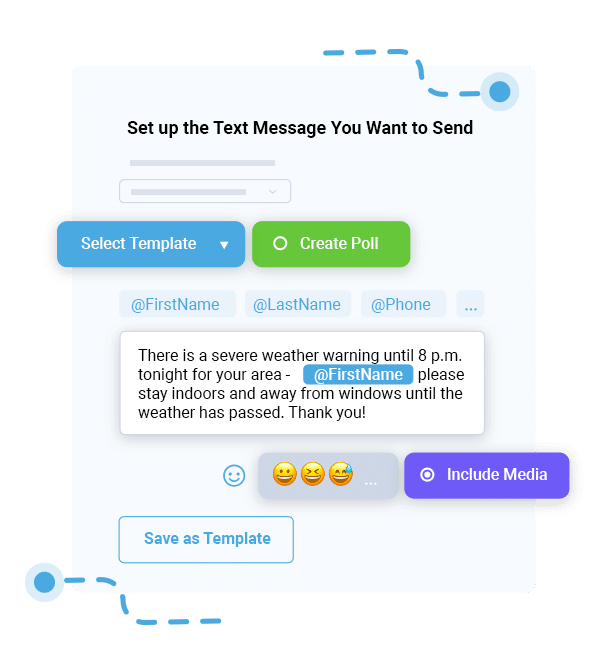
When a crisis hits or a sudden operational pivot is required, you cannot afford to wait. DialMyCalls provides a streamlined business SMS engine that enables operations teams to broadcast time-sensitive alerts to thousands of contacts simultaneously with a single click, bypassing standard communication delays.
Maintain Delivery Records and Communication Histories
DialMyCalls acts as your digital record-keeper. The platform automatically generates detailed delivery tracking reports and permanent communication logs for every text message sent. These unalterable reports show precisely when a text hit the carrier network and when it arrived on the recipient’s handset, providing your business with a clear, auditable trail.
Reach Audiences Through SMS, Voice, and Email
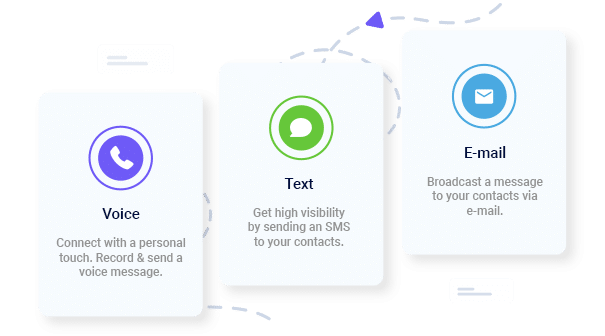
To support rigorous multi-channel compliance, DialMyCalls allows organizations to combine their outreach efforts. You can construct a single notification campaign that deploys an SMS text, an automated voice broadcast, and an email update simultaneously, guaranteeing maximum message visibility and bulletproof notice redundancy.
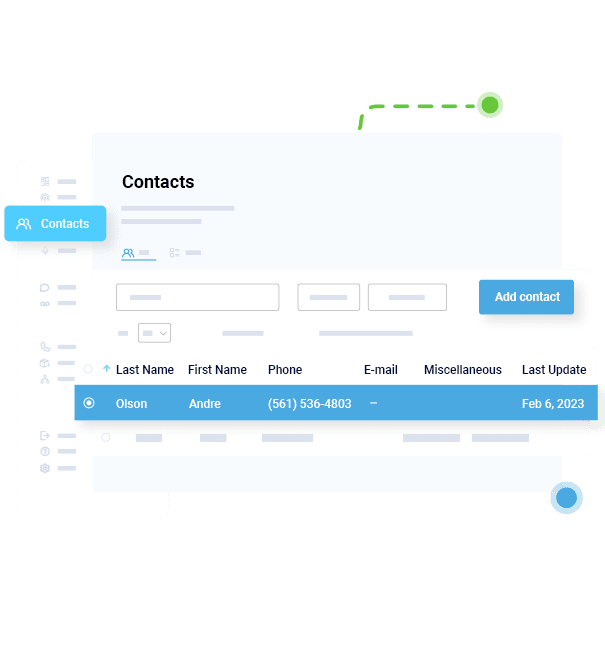
Organize Recipients Through Contact Management
Managing data across massive databases can get incredibly messy. The DialMyCalls contact management portal allows you to easily segment your recipients into distinct, organized groups based on their specific location, job site, residential building, or organizational role, ensuring every notice boasts exceptional relevance.
Improve Communication Visibility Across Teams
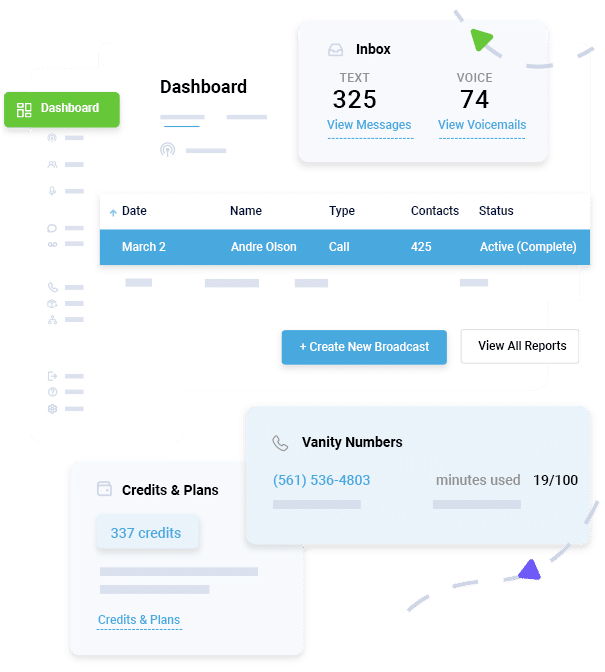
The platform features an intuitive, centralized dashboard that gives your entire management team visibility into outbound campaigns. HR directors, property managers, and security coordinators can collaborate within the same platform, checking delivery statuses, reviewing historical templates, and ensuring organizational consistency across all locations.
Support Operational and Emergency Notification Workflows
Whether your goal is managing daily shift changes or broadcasting critical weather alerts during an active crisis, DialMyCalls scales effortlessly to match your operational demands. The infrastructure ensures your team stays connected, informed, and fully aligned while maintaining the rigorous record keeping your legal department requires.
Ready to secure your communication trail and modernize your notification workflow? Sign up for a free account with DialMyCalls today and unlock trackable, compliant mobile communications for your organization.
Conclusion
A text message can absolutely satisfy the requirement for written notice in many everyday operational scenarios, but it is never an automatic, all-purpose replacement for formal paper documents. The ultimate validity of an SMS notice rests entirely on explicit recipient consent, the terms of your contracts, and your technical ability to prove transmission.
Stop treating your official mobile outreach like a casual personal conversation. By anchoring your strategy around bulletproof delivery tracking, standardized text templates, and robust multi-channel redundancy, you capture the blazing speed of mobile screens while thoroughly protecting your organization from compliance liabilities. Move away from unverified personal texts and adopt a structured, auditable mass notification approach to keep your entire operation safe, informed, and completely documented.
Limitations
This article provides general informational overview and should not be interpreted as formal legal advice. Compliance laws, housing codes, and labor regulations vary extensively across local, state, and federal jurisdictions. Organizations must consult qualified legal counsel and review their industry-specific contractual obligations before relying on SMS text messaging as a substitute for traditional physical written notice.
Is a text message legally considered written notice?
In many commercial and operational settings, yes, a text message can be considered written notice. Federal and state laws like the E-SIGN Act and UETA establish that electronic records satisfy traditional written requirements. However, this is only true if the recipient has previously consented to digital communication and the contract or local law doesn’t explicitly mandate a physical delivery method like certified mail.
Does the E-SIGN Act recognize text messages as written communication?
Yes, the federal E-SIGN Act explicitly grants electronic records and digital communications the exact same legal status as traditional physical paper records. Because a text message creates an archivable, digital data log that can be stored and retrieved later, it fits the legal definition of an electronic record.
When is a text message not sufficient as legal notice?
A text message fails as legal notice for high-stakes actions like formal court subpoenas, lawsuits, foreclosure steps, and eviction notices. These procedures are strictly governed by specific local civil codes that almost always mandate hand-delivery by a process server or physical certified mail to verify due process.
Can landlords send tenant notifications by text message?
Landlords can use text messaging for non-emergency operational alerts—such as routine maintenance notices, parking updates, or community event reminders—provided the tenant opted in via the lease. However, formal legal actions, such as a notice to quit or an eviction warning, usually require a physically served document to hold up in housing court.
Can employers use text messages for employment notifications?
Absolutely. Employers routinely rely on SMS for shift reminders, open roster announcements, policy alerts, and emergency team updates. To do so compliantly, the company must secure a mobile opt-in from the worker during onboarding and maintain secure delivery logs to preserve a clear audit trail of the communication history.
What documentation is needed when using SMS for notices?
To maintain full compliance, you need an unalterable audit trail. This must include documented proof of the recipient’s initial consent, the exact timestamp of when the text was dispatched, the complete text content delivered, and a carrier-verified delivery confirmation record showing the message successfully hit the recipient’s phone.
Can contracts allow text messages to qualify as written notice?
Yes. If two parties sign a commercial contract containing an explicit “electronic communications clause” stating that text messaging is an acceptable method for delivering written notices, courts will routinely uphold those text alerts as contractually binding.
Are text messages legally binding?
Yes, text messages can be legally binding. Because they constitute a written electronic record under UETA and the E-SIGN Act, texts can be used in court to prove contractual agreements, confirmation of terms, admissions of liability, or the receipt of operational disclosures.
What risks exist when relying solely on SMS for notice delivery?
The primary risks include carrier filtering (where networks accidentally block texts as spam), network delivery delays, outdated recipient contact information, missing consent trails, and the complete lack of a verified audit trail if messages are sent from unmonitored personal cell phones.
Maximize Outreach, Save Time
Start Transforming Your Communication with Mass Texting
Tim Smith is the Media Manager at DialMyCalls, where he has leveraged his expertise in telecommunications, SaaS, SEO optimization, technical writing, and mass communication systems since 2011. Tim is a seasoned professional with over 12 years at DialMyCalls and 15+ years of online writing experience.
“I am a youth minister and have spent hours in the past calling students individually to remind them of an upcoming event or to get out an urgent announcement. With DialMyCalls.com, I cut that time down to about 1 minute. I also love how I can see exactly who answered live and how long they listened so I know if they heard the whole message. DialMyCalls.com is the best website I have stumbled upon all year! Thanks!”
Real Results, Real ReviewsOver 40,000 customers trust our platform – and it shows.
4.3
502 Reviews
4.7
836 Reviews
Author
Tim SmithMedia Manager
Tim Smith is the Media Manager at DialMyCalls, where he has leveraged his expertise in telecommunications, SaaS, SEO optimization, technical writing, and mass communication systems since 2011. Tim is a seasoned professional with over 12 years at DialMyCalls and 15+ years of online writing experience.
“I am a youth minister and have spent hours in the past calling students individually to remind them of an upcoming event or to get out an urgent announcement. With DialMyCalls.com, I cut that time down to about 1 minute. I also love how I can see exactly who answered live and how long they listened so I know if they heard the whole message. DialMyCalls.com is the best website I have stumbled upon all year! Thanks!”
Fill out the form below to get a fast custom pricing quote specific for your
organization.Want to speak to our sales team now? Call us at
1-800-928-2086
Thank you!
A representative will be reaching out to you soon.
For immediate help you can call us on
800-928-2086.
Try Out DialMyCalls Now?
Enter a new password and click create account and you'll be able to send 25 test messages now.
Send A Sample Broadcast
We'll send a sample call or text to your phone right now. Remember when you use DialMyCalls you can record your message in your own voice. When the phone rings just pick up and say "Hello" to hear the message.