10DLC messaging allows businesses to send compliant A2P SMS using standard 10-digit phone numbers while meeting carrier requirements from AT&T, T-Mobile, and Verizon. Registration through The Campaign Registry improves deliverability, reduces spam filtering, and assigns approved throughput levels based on brand trust and campaign type. This guide explains how 10DLC works, how registration happens, and how it compares with toll-free SMS and dedicated short codes. Businesses sending alerts, reminders, marketing messages, or internal notifications can use 10DLC to reach customers reliably while staying compliant with U.S. SMS standards.
The approach is now critical, as carriers, including AT&T, T-Mobile, and Verizon, enforce registration to reduce spam, improve deliverability, and protect consumers. On top of that, businesses must register their brand and campaigns with The Campaign Registry before sending SMS at scale.
Companies choosing an SMS channel often compare 10DLC vs short codes (or 10DLC vs toll-free SMS) based on cost, setup time, throughput, and use case.
In simple terms, 10DLC refers to a standard local phone number used for business texting.
A typical 10DLC number looks like: (555) 123-4567
Consumers already use numbers like this for everyday conversations. Carriers in the U.S. and Canada now allow businesses to use these same local numbers for A2P messaging, as long as brands register and follow carrier rules.
How 10DLC Differs From Short Codes
Short codes use 5- or 6-digit numbers like 12345. Brands once relied heavily on them for bulk SMS campaigns. Carriers now push businesses toward registered 10DLC numbers instead.
Key differences include:
10DLC: Standard phone number, local presence, lower cost, brand registration required
Short codes: Short numbers, high SMS throughput, expensive setup, long approval cycles
10DLC messaging blends everyday familiarity with business-grade compliance, making it the preferred option for most organizations.
Why Carriers Regulate 10DLC Messaging
Carriers introduced 10DLC registration to fight spam, phishing, and fraud while improving deliverability for legitimate businesses. AT&T, T-Mobile, and Verizon now rely on The Campaign Registry (TCR) to manage brand and campaign data, and registration allows carriers to:
Verify business identity
Review message use cases
Apply appropriate throughput limits
Reduce spam filtering errors
Take note that unregistered SMS traffic often faces heavy filtering, throttling, or outright blocking.
How 10DLC Registration Works
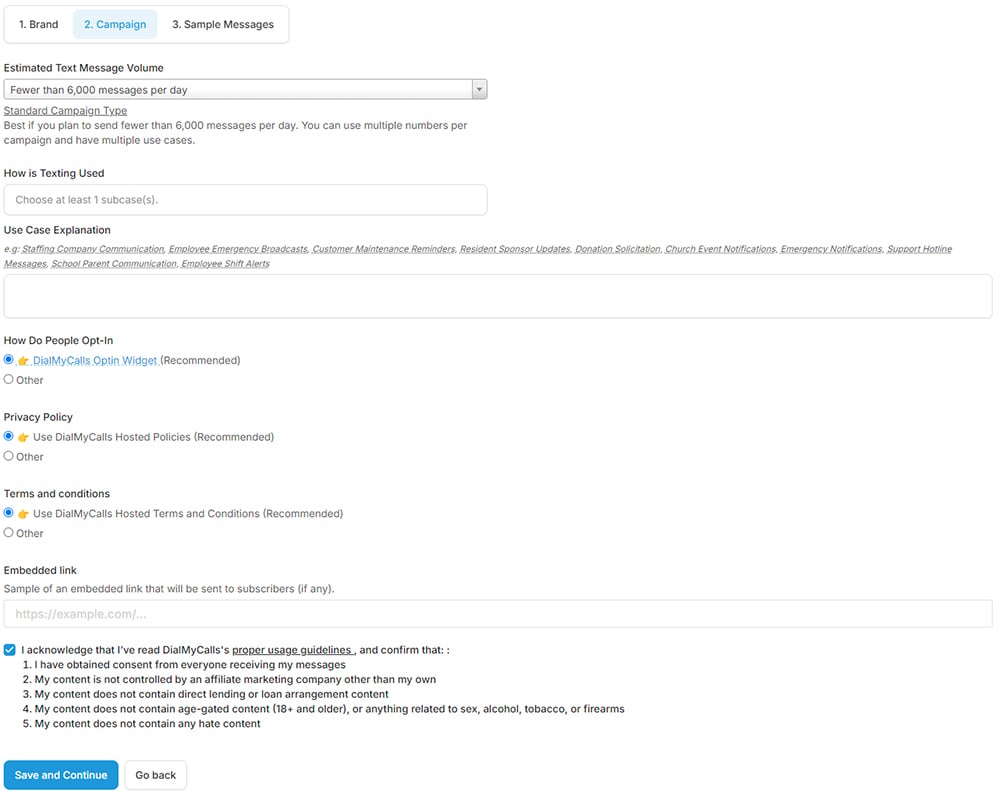
10DLC registration happens in two layers: brand registration and campaign registration. Both steps play a role in carrier-approved SMS messaging.
Brand Registration Explained
Brand registration identifies your business to carriers. During this step, companies submit:
Legal business name
Tax ID or EIN
Business address
Industry category
Contact details
Carriers use this data to confirm legitimacy and assign a trust score.
Campaign Registration Explained
Campaign registration defines how your company plans to use SMS. Each messaging use case requires its own campaign registration.
Examples include:
Appointment reminders
Marketing promotions
Two-factor authentication
Customer support updates
Account alerts
A2P 10DLC registration for US SMS requires a one-time brand fee ($4–$19) and a $15 campaign vetting fee, plus monthly campaign fees ($1.50–$10) based on volume. Approval usually takes a few business days to two weeks. However, common, compliant campaigns are approved faster than specialized ones.
These numbers offer practical advantages over short codes and unregistered long codes. Businesses gain better deliverability, lower costs, and more flexibility across communication workflows.
Local Business Numbers Customers Recognize
Customers trust familiar-looking numbers. A local 10-digit number feels personal and conversational, which increases response rates for customer service and appointment messaging.
Voice and SMS From One Number
10DLC numbers support both voice calls and text messages. Teams can manage inbound calls and outbound SMS from the same line, keeping customer conversations consistent.
Lower Costs Compared to Short Codes
Short codes often cost thousands per month in leasing fees alone. 10DLC messaging typically charges low costs for:
Brand registration fees
Campaign registration fees
Per-message usage rates
Most businesses save significantly by switching to registered long codes.
Private Sender Identity
Shared short codes group multiple brands under the same number, meaning one bad actor can affect deliverability for everyone. 10DLC campaigns operate under your brand identity, protecting sender reputation.
Better Customer Engagement
Customers already text friends and family using 10-digit numbers. Messages from similar-looking numbers blend naturally into inboxes, driving higher open and reply rates.
10DLC vs Other SMS Messaging Options
When businesses choose an A2P SMS channel, cost, speed, carrier compliance, and message volume are top priorities. The right option depends on your audience size, campaign type, and throughput needs.
Here’s a straightforward comparison of three major choices:
Feature
10DLC
Toll-free SMS
Dedicated Short Code
Cost
Lower monthly and per-message fees
Moderate monthly + per message
Highest monthly + setup fees
Setup Time
Days to a week
Days to a week
Weeks to months
Registration Required
Yes (brand + campaign)
Yes (brand + campaign)
Yes (carrier + registry)
Throughput
Moderate (varies by campaign)
Moderate-high
Very high
Deliverability
Strong when registered and compliant
Very strong
Very strong
Best Use Cases
Local engagement, reminders, alerts, promos
Customer service, national outreach
High-volume marketing, mass alerts
When Should Businesses Use 10DLC?
10-digit long code SMS works well across industries and communication types.
High-Response Customer Communication
Appointment confirmations
Delivery notifications
Order status updates
Account alerts
Two-factor authentication
Marketing and Engagement for SMBs (with Consent)
Event reminders
Loyalty program messages
Limited-time promotions
Feedback requests
Operations and Internal Alerts
Staff scheduling updates
Emergency notifications
System outage alerts
How DialMyCalls Supports 10DLC Messaging
DialMyCalls helps businesses register, manage, and scale 10DLC campaigns without dealing directly with carrier paperwork. Teams gain access to compliant messaging tools while avoiding deliverability risks tied to unregistered traffic.
DialMyCalls supports:
Brand registration through The Campaign Registry
Campaign registration for marketing, alerts, and transactional messaging
Local number provisioning
Canada and U.S. SMS compliance monitoring
Message throughput management
Small businesses, schools, healthcare providers, and enterprises all rely on DialMyCalls for fast, compliant outbound messaging.
Making the Switch to 10DLC
10DLC messaging now powers most compliant A2P SMS traffic, and with this approach, businesses gain affordable local numbers, better deliverability, and clear compliance pathways with AT&T, T-Mobile, Verizon, and CTIA standards.
Companies that rely on SMS for alerts, reminders, promotions, or customer engagement benefit from faster approvals and stronger inbox placement compared to legacy short codes.
Contact us today to learn more about DialMyCalls, a platform that helps organizations register, launch, and scale 10-digit long code SMS campaigns with confidence – while keeping carrier A2P 10DLC compliance, throughput, and deliverability front and center.
10DLC Messaging FAQs
What is 10DLC messaging?
10DLC messaging uses standard 10-digit phone numbers for business texting. Companies send A2P SMS from local numbers instead of short codes or toll-free numbers. In this approach, carriers require registration to verify sender identity, apply appropriate throughput, and reduce spam filtering.
Is 10DLC required for A2P SMS?
Yes. U.S. carriers, including AT&T, T-Mobile, and Verizon, require brand and campaign registration for A2P 10DLC traffic. Unregistered long code messaging often faces filtering, blocking, or delivery failures.
How long does 10DLC registration take?
Most brand and campaign registrations are complete within a few business days. Some industries and message categories require additional carrier review, which can extend approval timelines. Providers like DialMyCalls manage the registration process and help speed up onboarding.
Is 10DLC better than short codes?
10DLC works better for most businesses because it costs less, launches faster, and supports local number branding. Short codes still provide higher throughput, but most organizations don’t need that level of volume. For alerts, reminders, customer engagement, and marketing campaigns, 10DLC messaging offers a more practical solution.
Can 10DLC send MMS messages?
Yes. Most carriers support MMS on registered 10DLC campaigns. Campaign approval still applies to multimedia content, and throughput limits vary based on carrier policies and brand trust scores.
What happens if 10DLC messages are not registered?
Carriers may block, throttle, or heavily filter unregistered traffic. Message delivery rates often drop sharply, and numbers may face suspension. Registration protects deliverability and ensures compliance with CTIA guidelines and carrier policies.
Maximize Outreach, Save Time
Start Transforming Your Communication with Mass Texting
Saad Z. Asif is a telecom executive and author with over 27 years of global experience in 3G, 4G, 5G, and IoT innovation. He has held leadership roles at Verizon, T-Mobile, Telenor, and VEON, and advised governments on award-winning telecom policies. Saad is the founder of Galaxy Technology Consulting LLC and author of three books on telecommunications.
“I am a youth minister and have spent hours in the past calling students individually to remind them of an upcoming event or to get out an urgent announcement. With DialMyCalls.com, I cut that time down to about 1 minute. I also love how I can see exactly who answered live and how long they listened so I know if they heard the whole message. DialMyCalls.com is the best website I have stumbled upon all year! Thanks!”
Real Results, Real ReviewsOver 40,000 customers trust our platform – and it shows.
4.3
502 Reviews
4.7
836 Reviews
Author
Saad Z. AsifChief Analyst
Saad Z. Asif is a telecom executive and author with over 27 years of global experience in 3G, 4G, 5G, and IoT innovation. He has held leadership roles at Verizon, T-Mobile, Telenor, and VEON, and advised governments on award-winning telecom policies. Saad is the founder of Galaxy Technology Consulting LLC and author of three books on telecommunications.
“I am a youth minister and have spent hours in the past calling students individually to remind them of an upcoming event or to get out an urgent announcement. With DialMyCalls.com, I cut that time down to about 1 minute. I also love how I can see exactly who answered live and how long they listened so I know if they heard the whole message. DialMyCalls.com is the best website I have stumbled upon all year! Thanks!”
Fill out the form below to get a fast custom pricing quote specific for your
organization.Want to speak to our sales team now? Call us at
1-800-928-2086
Thank you!
A representative will be reaching out to you soon.
For immediate help you can call us on
800-928-2086.
Try Out DialMyCalls Now?
Enter a new password and click create account and you'll be able to send 25 test messages now.
Send A Sample Broadcast
We'll send a sample call or text to your phone right now. Remember when you use DialMyCalls you can record your message in your own voice. When the phone rings just pick up and say "Hello" to hear the message.